
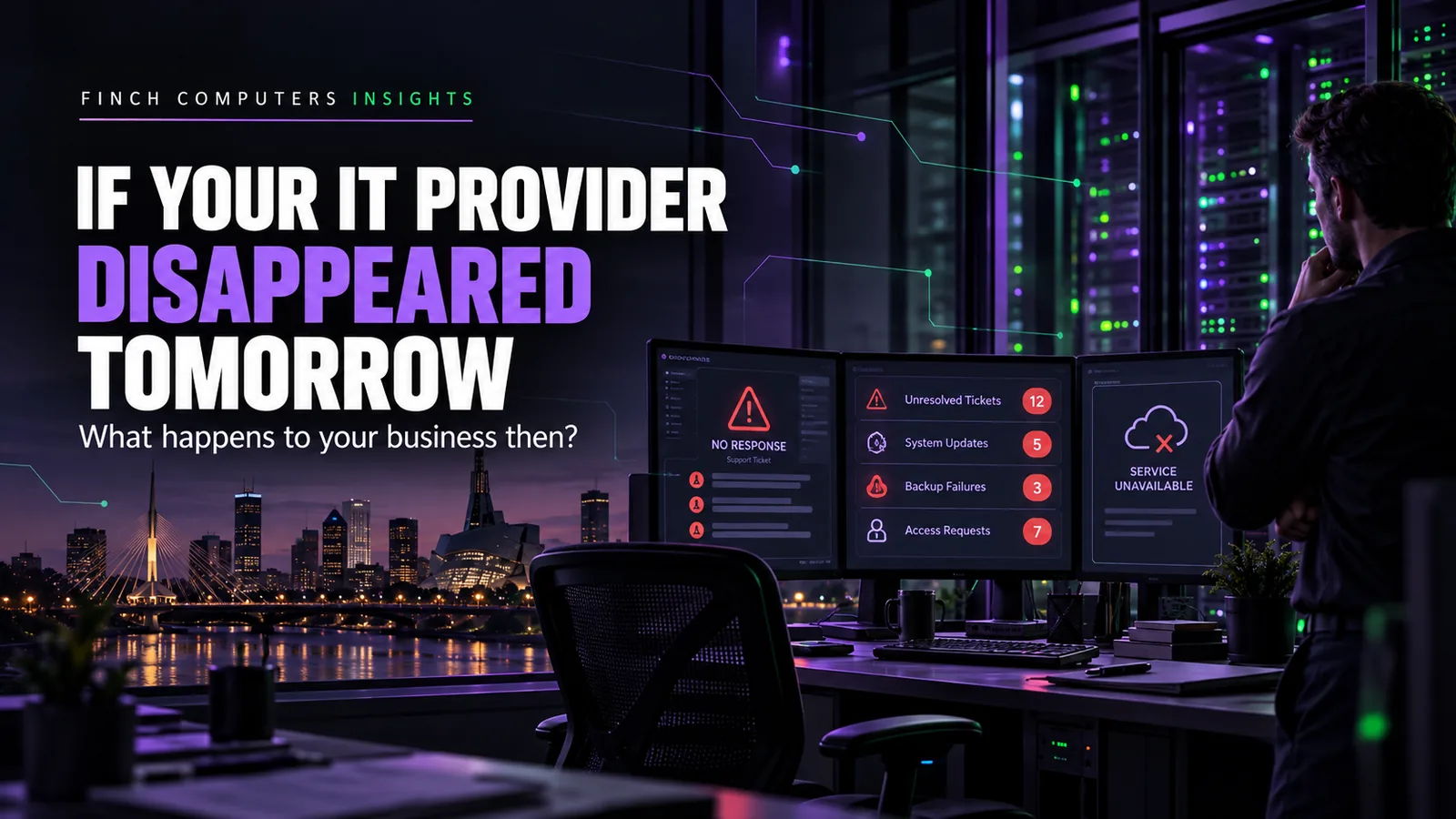
Many companies outsource IT because it makes practical sense. You get expertise, support coverage and help managing systems that most business owners do not want to deal with personally. But if your IT provider disappeared tomorrow, would your business keep running?
That arrangement can work very well. The trouble starts when the relationship becomes so provider-dependent that the business no longer knows how anything is set up, who controls the key systems or what would happen if the provider suddenly stopped responding.
It is not a comfortable question, but it is an important one.
If your IT provider disappeared tomorrow, what happens to your business then?
The danger is usually dependency, not outsourcing itself
There is nothing inherently wrong with hiring outside IT support. The issue is unmanaged dependency.
A business can become dependent on one provider for:
- Microsoft 365 administration.
- Network equipment and firewall access.
- Backup systems and recovery processes.
- Vendor relationships and renewals.
- Documentation and passwords.
- Website hosting and DNS.
- Remote access and monitoring tools.
- Support workflows and ticket history.
If all of that knowledge and control sits outside the business, the provider effectively becomes a single point of failure.
What can go wrong?
When a provider is unavailable, unresponsive or no longer involved, businesses often discover that they do not have:
- A current inventory of systems and subscriptions.
- Administrative access to cloud platforms.
- Copies of essential documentation.
- Clear ownership of domains, backups or licensing.
- A record of who to contact for vendors and renewals.
- A clean handover plan for another provider.
At that point, even routine work can become disruptive. A password reset becomes a project. A hardware replacement stalls. A website migration gets delayed. A security event becomes harder to manage because the new team is starting from scratch.
Warning signs that your business is too dependent
Here are a few practical warning signs:
Nobody internally knows where the critical logins are
If every major system requires calling the IT provider, your business may not be in control.
Documentation is missing or incomplete
If there is no current record of systems, vendors, licensing, networks or backup arrangements, recovery and transitions become harder.
You do not know who owns the backups
A backup solution you cannot independently verify is not the same as resilience.
Changing providers feels impossible
If the business believes it is trapped because too much knowledge sits with the current provider, dependency has become a business risk.
The business continuity angle
This is not just an IT management issue. It is a continuity issue.
Operational resilience means the business can continue functioning even when a key outside relationship changes. That does not mean the business owner should personally manage every technical detail. It means the business should have enough documented control to transition safely when needed.
That includes:
- Knowing what systems exist.
- Understanding who owns key accounts.
- Maintaining internal visibility over critical vendors.
- Having a documented transition path.
- Preserving access to data, backups and communication systems.
Prepare before you need a transition
Provider changes are much smoother when the business prepares early.
A structured transition review can help identify:
- Hidden dependencies.
- Missing documentation.
- Access gaps.
- License ownership issues.
- Backup retention questions.
- Potential disruption points.
The goal is not confrontation. The goal is preparedness.
Businesses should be able to change providers without chaos, confusion or guesswork.
No silent transitions. No surprises.
An effective provider transition depends on three things: communication, documentation and accountability.
Before changing providers, the business should know what is being handed over, what is being removed, what still needs attention and who is responsible at each stage.
When that process is managed properly, the business stays in control.
Ask the question now
You do not need to be unhappy with your current provider to ask whether the business could function without them.
In fact, the best time to review that risk is while the relationship is still working.
If your business cannot clearly answer what would happen if your IT provider disappeared tomorrow, it is time to take a closer look.
Finch Computers helps businesses prepare for provider transitions with better visibility, documented responsibilities and cleaner handovers. Since 1998. Zero Excuses.